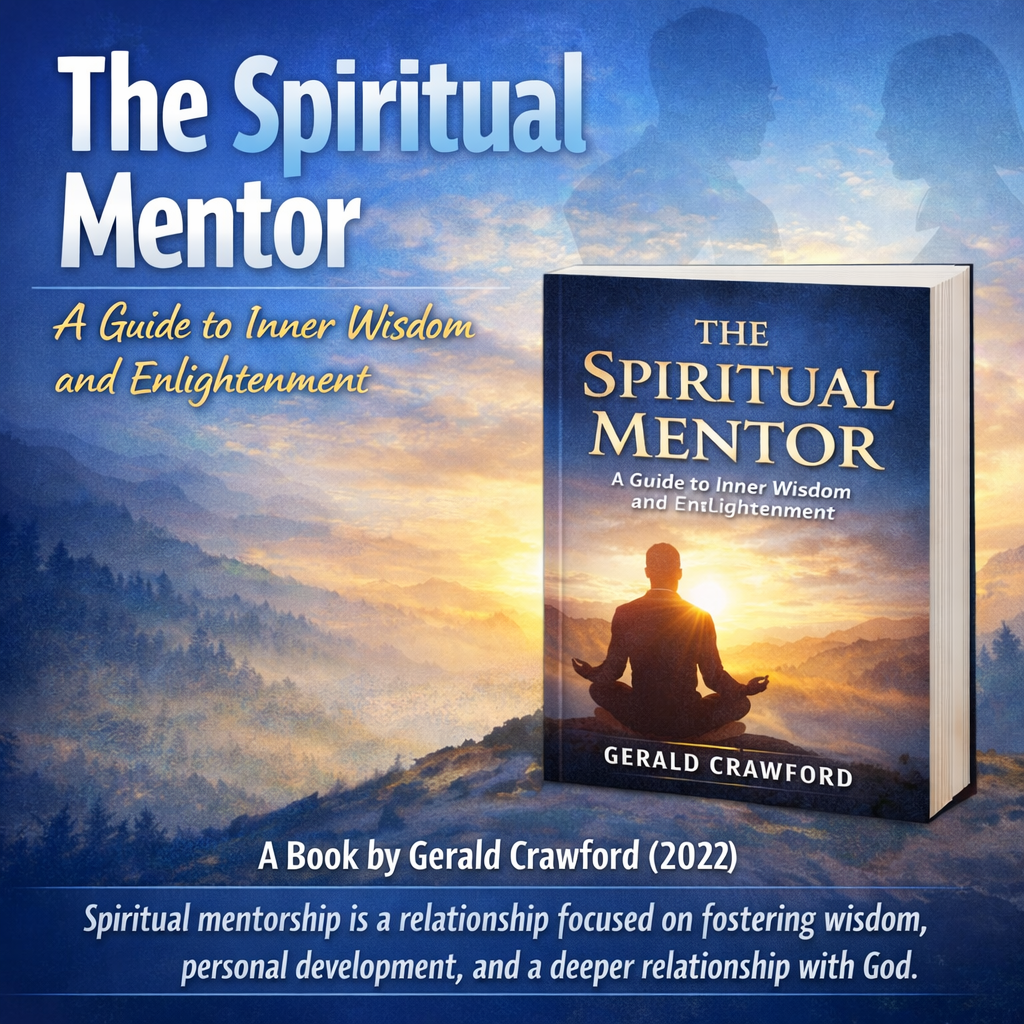
The Spiritual Mentor: A Guide to Inner Wisdom and Enlightenment - A Book by Gerald Crawford (2022 Edition)

Spiritual mentorship is a relationship where we focus on fostering wisdom, personal development, and a deeper relationship with God.

Page 7 of 34

Tap Into Your Inner Wisdom by Stopping

The messages your heart has for you are not on Facebook feeds, TV programs, emails or nights at the pub. We actually have to stop what we’re doing, find space in our schedules and escape from the busyness of daily life to begin to understand what’s going on within. We live much of our lives on the outside these days, particularly with our 24/7 connection and the need to be constantly entertained. Pausing from this is the first step that leads to us finding the space to listen.

In today’s fast-paced world, it’s easy to get caught up in the hustle and bustle of daily life. We’re constantly on the go, rushing from one task to the next, and often forget to take a moment to pause and reflect. However, it’s in these moments of stillness that we can tap into our inner wisdom and access the deepest, most profound parts of ourselves.

The Power of Stopping

Stopping may seem like a simple concept, but it’s a powerful tool that can help us connect with our inner wisdom. When we stop, we create space for ourselves to breathe, reflect, and listen to our inner voice. We can quiet the mind, calm the body, and tune into our intuition.

Benefits of Stopping

1. Reduces stress and anxiety: Stopping helps to calm the mind and body, reducing feelings of stress and anxiety.

2. Increases self-awareness: By taking a moment to pause and reflect, we can gain a deeper understanding of ourselves, our thoughts, and our emotions.

3. Improves decision-making: Stopping allows us to tune into our intuition, making it easier to make decisions that align with our values and goals.

4. Enhances creativity: When we stop, we can tap into our creative potential, allowing new ideas and inspiration to flow in.

5. Fosters inner wisdom: Stopping helps us connect with our inner wisdom, allowing us to access deeper levels of understanding and guidance.

Simple Ways to Stop and Tap into Your Inner Wisdom

1. Take a few deep breaths: When you feel yourself getting caught up in the hustle and bustle of daily life, take a few deep breaths and pause for a moment.

2. Practice meditation or mindfulness: Set aside time each day to practice meditation or mindfulness, focusing on your breath and letting go of distracting thoughts.

3. Take a walk in nature: Spending time in nature can be a great way to slow down and connect with your inner wisdom.

4. Engage in a creative activity: Pursue a creative activity that brings you joy, such as painting, writing, or playing music.

5. Schedule downtime: Make sure to schedule time for yourself to rest and recharge, free from the demands of work and other responsibilities.

Working with a Spiritual Mentor

If you’re looking to tap into your inner wisdom and access deeper levels of understanding and guidance, consider working with a spiritual mentor like Gerald Crawford. Gerald can help you:

1. Develop a greater sense of self-awareness: Through guided meditation and introspection, you can gain a deeper understanding of yourself and your place in the world.

2. Connect with your inner guide: Gerald can help you connect with your inner guide, allowing you to access deeper levels of wisdom and guidance.

3. Navigate life’s challenges: With Gerald’s guidance, you can learn to navigate life’s challenges with greater ease and confidence, trusting in your own inner wisdom to guide you.

By stopping and taking a moment to pause, we can tap into our inner wisdom and access the deepest, most profound parts of ourselves. Remember to schedule downtime, practice mindfulness, and seek guidance from a spiritual mentor like Gerald Crawford to help you on your journey.


Advanced Mindfulness and Meditation Techniques – Mindfulness in relationships and daily activities

As we explore advanced mindfulness and meditation techniques, it’s essential to bring mindfulness into our daily lives, including our relationships and daily activities. By doing so, we can cultivate greater awareness, compassion, and understanding, leading to more harmonious and fulfilling interactions with others and a greater sense of purpose and fulfillment.

Mindfulness in Relationships

Mindfulness in relationships involves being fully present and engaged with others, without judgment or distraction. This can be applied to various relationships, including romantic partnerships, friendships, family relationships, and even interactions with colleagues or acquaintances.

1. Active listening: When engaging with others, focus on fully listening to what they’re saying, without interrupting or mentally preparing your response. This helps to build trust, understanding, and deepens connections.

2. Empathy and compassion: Practice putting yourself in others’ shoes, trying to understand their perspectives and feelings. This cultivates empathy and compassion, leading to more harmonious and supportive relationships.

3. Non-judgmental awareness: Notice when you’re judgmentally thinking about others, and gently bring your attention back to the present moment. This helps to reduce conflict and promotes greater understanding and acceptance.

4. Gratitude and appreciation: Cultivate gratitude and appreciation for the people in your life, recognizing the positive contributions they make and the value they bring to your life.

Mindfulness in Daily Activities

Mindfulness in daily activities involves bringing awareness and presence to everyday tasks, transforming them into opportunities for growth, learning, and enjoyment.

1. Eating mindfully: Savor your food, paying attention to the flavors, textures, and aromas. Eat slowly, and notice the sensations in your body as you eat.

2. Mindful movement: Engage in physical activities like walking, yoga, or tai chi with a mindful attitude, paying attention to your breath, posture, and the sensations in your body.

3. Daily routines: Bring mindfulness to everyday tasks like showering, driving, or doing household chores. Notice the sensations, sights, and sounds around you, and try to find a sense of curiosity and wonder.

4. Work and productivity: Apply mindfulness to your work and productivity, focusing on the present moment, and letting go of distractions. This can help you stay centered, motivated, and efficient.

Tips for Practicing Mindfulness in Relationships and Daily Activities

1. Start small: Begin with short periods of mindfulness practice, such as taking a few deep breaths before a conversation or paying attention to your senses while eating.

2. Be consistent: Incorporate mindfulness into your daily routine, making it a habit to be present and aware in your interactions and activities.

3. Use reminders: Place reminders, such as stickers or notes, in strategic locations to remind you to practice mindfulness throughout the day.

4. Practice self-compassion: Be gentle with yourself when you find your mind wandering or struggling to stay present. Gently bring your attention back to the present moment, without judgment.

5. Seek support: Share your mindfulness practice with friends or family, and consider joining a mindfulness group or seeking guidance from a mindfulness coach.

By bringing mindfulness into your relationships and daily activities, you can:

* Cultivate deeper connections and understanding with others

* Find greater joy and fulfillment in everyday tasks

* Develop a greater sense of awareness, compassion, and empathy

* Improve your overall well-being and quality of life

Remember, the key to mindfulness is to approach each moment with curiosity, openness, and a willingness to learn. By doing so, you can transform your relationships and daily activities into opportunities for growth, connection, and joy.

Free Will

Free will is a complex and multifaceted concept that refers to the ability of individuals to make choices that are not entirely determined by external factors, such as genetics, environment, or past experiences.

In essence, free will implies that humans have the capacity for self-directed action, allowing them to choose between different options and shape their own lives. This concept is often associated with moral responsibility, as it suggests that individuals can be held accountable for their decisions and actions.

There are different perspectives on free will, and philosophers have debated its existence and nature for a long time. Here are some of the main arguments:

*Determinism vs. Indeterminism*: Determinists argue that every event, including human decisions and actions, is the inevitable result of prior causes and is therefore predetermined. In contrast, indeterminists believe that some events, including human choices, are not entirely determined by prior causes and are therefore free.

*Compatibilism vs. Incompatibilism*: Compatibilists argue that free will is compatible with determinism, and that free will can exist even if our choices are influenced by external factors. In compatibilists, on the other hand, argue that free will requires indeterminism and that determinism is incompatible with free will.

*Libertarianism*: Libertarians argue that free will requires indeterminism and that individuals have the ability to make choices that are not entirely determined by prior causes.

*Challenges to free will*: Some challenges to the concept of free will come from:

1. *Neuroscience*: Studies in neuroscience have shown that brain activity often precedes conscious awareness of a decision, suggesting that our choices may be determined by brain processes rather than conscious free will.
2. *Genetics*: Genetic factors can influence behavior and decision-making, raising questions about the extent to which our choices are truly free.
3. *Environmental factors*: Environmental factors, such as upbringing and social conditioning, can shape our choices and behavior, leading some to argue that our choices are not entirely free.

*Implications of free will*: The concept of free will has significant implications for:

1. *Moral responsibility*: If we have free will, we can be held accountable for our actions. If we don’t, it’s harder to justify moral responsibility.
2. *Personal autonomy*: Free will is essential for personal autonomy, as it allows individuals to make choices that reflect their own values and goals.
3. *Justice and punishment*: The concept of free will informs our understanding of justice and punishment, as it raises questions about the extent to which individuals can be held responsible for their actions.

In conclusion, the concept of free will is complex and multifaceted, with different perspectives and challenges. While there is no straightforward answer to what free will is, understanding the various arguments and implications can help us better appreciate the nature of human choice and agency.

The Concept of Free Will

The concept of free will is a complex and multifaceted idea that can be found in various domains, including:

1. Philosophy: The concept of free will has been debated by philosophers for centuries, with different schools of thought offering varying perspectives. For example, determinism argues that human behavior is entirely determined by prior causes, while indeterminism suggests that human decisions are not entirely predetermined.

2. Religion: Many religious traditions, such as Christianity, Islam, and Judaism, emphasize the concept of free will, suggesting that humans have the ability to make choices that can influence their spiritual destiny.

3. Psychology: Psychologists have studied the concept of free will in relation to human behavior, motivation, and decision-making. Some theories, like social learning theory, suggest that human behavior is shaped by external factors, while others, like self-determination theory, emphasize the role of intrinsic motivation and personal autonomy.

4. Neuroscience: Recent advancements in neuroscience have led to a greater understanding of the neural basis of decision-making and the extent to which our choices are influenced by brain activity. Some researchers argue that our brain activity can predict our decisions before we’re consciously aware of them, which challenges the concept of free will.

5. Ethics and Morality: The concept of free will is also closely tied to moral responsibility, as it implies that individuals can be held accountable for their actions. If humans have free will, then they can be praised or blamed for their decisions and actions.

6. Law and Justice: The concept of free will is also relevant in the context of law and justice, as it informs our understanding of criminal responsibility and the notion of personal accountability.

Some of the key historical figures who have contributed to the concept of free will include:

* Ancient Greek philosophers like Aristotle and Epicurus

* Medieval thinkers like Thomas Aquinas and William of Ockham

* Modern philosophers like René Descartes, John Locke, and Immanuel Kant

* Contemporary philosophers like Jean-Paul Sartre, Martin Heidegger, and Daniel Dennett

These are just a few examples of where the concept of free will can be found. The idea of free will remains a topic of ongoing debate and discussion across various disciplines.


From a spiritual perspective, the concept of free will is often intertwined with the idea of personal responsibility and the notion that our choices have consequences. Many spiritual traditions believe that individuals have the power to make choices that can shape their lives and determine their spiritual paths.

In some spiritual frameworks, free will is seen as a sacred gift that allows individuals to exercise their moral agency and make decisions that align with their values and principles. This perspective emphasizes the importance of personal accountability and the idea that our choices can lead to spiritual growth, learning, and self-improvement.

Some spiritual traditions also suggest that our choices are not entirely our own, but are influenced by factors such as karma, destiny, or divine will. For example, in some Eastern spiritual traditions, the concept of karma suggests that our past actions influence our present circumstances, and that our current choices can shape our future experiences.

In other spiritual perspectives, free will is seen as an illusion, and our choices are believed to be determined by external factors such as fate, providence, or the will of a higher power. This view can be found in some religious traditions, where the idea is that our lives are part of a larger plan or divine design.

Ultimately, the spiritual perspective on free will encourages individuals to reflect on their values, intentions, and motivations, and to consider the potential consequences of their choices. By doing so, individuals can cultivate a deeper sense of personal responsibility, spiritual awareness, and purpose.

Guided Deep Meditation to Revealing Your Shadow Self

Find a quiet, comfortable, and peaceful space to sit or lie down, close your eyes, and take a deep breath in through your nose and out through your mouth. Allow yourself to relax, letting go of any tension or stress.

Grounding and Relaxation (5 minutes)

Imagine roots growing from the base of your spine, deep into the earth, anchoring you in stability and calmness. As you inhale, feel fresh energy entering your body, and as you exhale, feel any tension or worries leaving your body.

Visualize a warm, soothing light filling your body, starting from the crown of your head, flowing down to your toes, and filling any areas of tension or discomfort. Allow this light to dissolve any resistance, making you feel more relaxed and receptive.

Journey to the Shadow Realm (5 minutes)

Imagine yourself standing in front of a large, old, wooden door. The door is adorned with intricate carvings and symbols, representing the mysteries of your subconscious. Take a deep breath, and as you exhale, feel the door slowly creaking open.

As you step through the doorway, you find yourself in a dimly lit, mystical realm. The air is filled with an otherworldly energy, and you can sense the presence of your Shadow Self. Allow yourself to explore this realm, noticing the sights, sounds, and sensations that arise.

Meeting Your Shadow Self (10 minutes)

As you journey deeper into the Shadow Realm, you come face to face with a figure representing your Shadow Self. This figure may take on a human form, an animal, or a symbol. Allow yourself to observe and interact with this aspect of yourself, without judgment or fear.

Ask your Shadow Self questions, such as:

* What are your deepest desires and fears?

* What do you want me to know or understand about myself?

* What aspects of myself have I been denying or suppressing?

* How can I integrate your wisdom and power into my conscious awareness?

Listen to the responses, and allow yourself to receive any insights, emotions, or sensations that arise. Remember, your Shadow Self holds the keys to your deepest wisdom, creativity, and personal growth.

Integration and Reflection (5 minutes)

As you prepare to leave the Shadow Realm, take a moment to reflect on the insights and feelings you’ve received. Consider how you can apply this new awareness to your waking life, and what steps you can take to integrate your Shadow Self into your conscious awareness.

Imagine the wisdom and power of your Shadow Self merging with your conscious self, filling you with a sense of wholeness, balance, and newfound understanding. As you exhale, feel any remaining tension or resistance leaving your body, making space for the integration of your Shadow Self.

Returning to the Present (2 minutes)

Slowly begin to bring your attention back to the present moment, noticing the sensation of your body, the sounds around you, and the sensation of the air on your skin. Take a deep breath in, and as you exhale, feel yourself fully returning to the present, refreshed, renewed, and more aware of your Shadow Self.

Remember, the journey into the Shadow Realm is an ongoing process, and the insights you’ve received today are just the beginning. Be patient, kind, and compassionate with yourself as you continue to explore and integrate your Shadow Self.

« Older posts Newer posts »

Step-up and get your seat on my VIP Spiritual Mentorship Program for 2026

X
Back a Buddy Show your Support